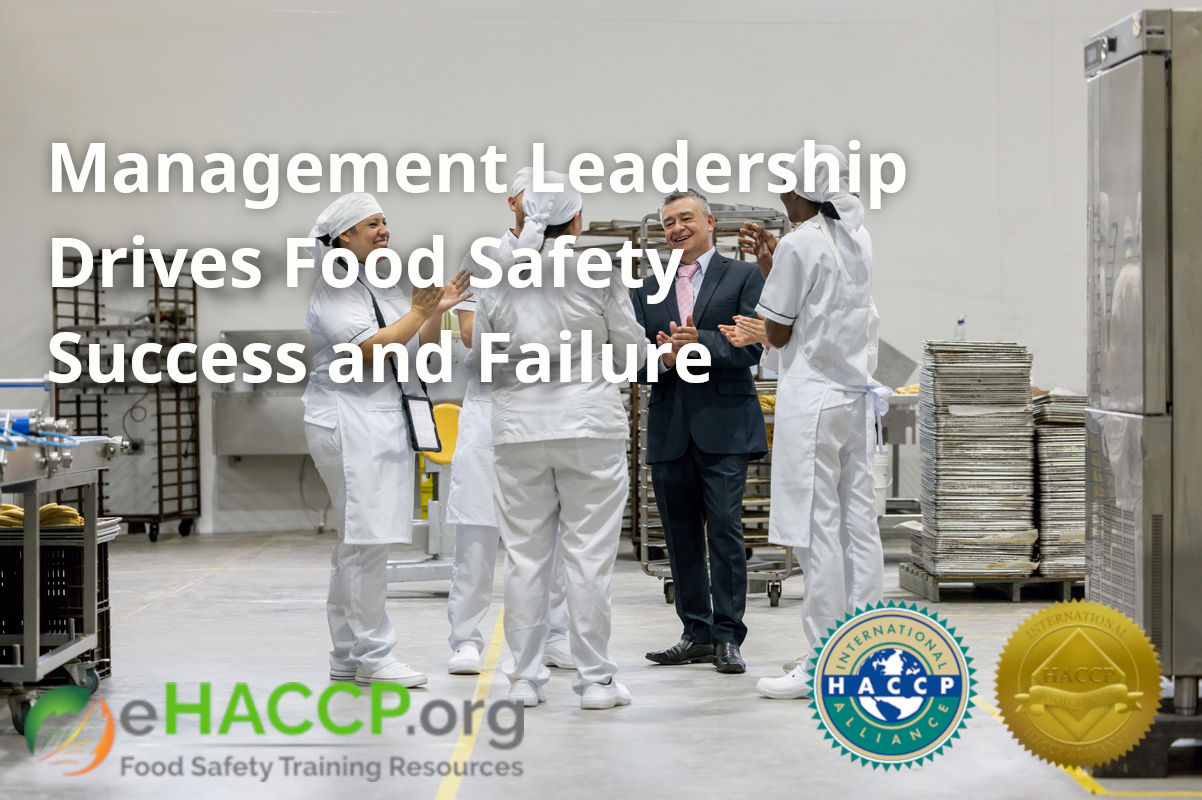
Nothing has a greater impact on food safety performance than management commitment. When leadership is engaged, food safety systems work.
LUNENBURG, NOVA SCOTIA, CANADA, May 1, 2026 /EINPresswire.com/ — Across the global food industry, the pattern is consistent: weak management commitment leads directly to breakdowns in HACCP systems, inconsistent procedures, and disengaged employees. Over time, this results in compliance failures, increased risk of contamination, and a higher likelihood of recalls and regulatory action.
Leadership Drives Success and Failure
Food safety is not a paperwork exercise created to meet regulatory and client requirements; it is a management responsibility that puts the safety of consumers above all else.
Without active leadership food safety and HACCP plans become overly complex, incomplete, or outdated while monitoring and verification lose effectiveness. Employees lack training, ownership, and accountability and preventive systems revert to reactive, basic controls. The result is a system that may appear compliant on paper but fails in practice.
Organizations with poor management engagement often experience recurring audit failures, weak recordkeeping, and ongoing non-conformities—issues that directly impact both operational performance and brand reputation.
The Business Cost of Inaction
Lack of management commitment is one of the primary reasons companies fail to implement or sustain HACCP and food safety management systems.
The consequences extend far beyond compliance. The most serious are an increased risk of recalls and product withdrawals, loss of customer trust and market access, regulatory penalties and legal exposure and significant financial and reputational damage.
In many high-profile food safety incidents, the root cause is not a lack of technical knowledge but a lack of leadership and accountability.
From Compliance to Competitive Advantage
Organizations that succeed in respect to passing audits and always being audit ready treat food safety as a core business function not a regulatory burden. They link food safety to measurable business outcomes like risk reduction and operational efficiency, establish clear leadership roles and accountability structures, integrate HACCP into daily operations and executive decision-making, and track performance through meaningful KPIs and continuous improvement.
When leadership is visible and engaged, food safety becomes embedded in company culture, not enforced through compliance alone.
Training Helps Drive Management Commitment
Training providers, such as eHACCP.org, are helping organizations bridge the gap between compliance and true leadership engagement in food safety.
Through its online HACCP training courses and corporate learning management system (LMS), eHACCP.org enables companies to:
• Standardize HACCP training across multiple locations and teams
• Track employee competency, certifications, and compliance in real time
• Provide management with clear visibility into food safety performance
• Reinforce accountability through structured training, reporting, and governance tools
By aligning training, performance metrics, and leadership oversight, eHACCP.org helps organizations transform food safety from a reactive requirement into a measurable business priority.
Turning Resistance into a Buy-In Commitment Culture
One of the biggest barriers to implementation is perceived cost and complexity. Leading organizations overcome this by focusing on practical, phased approaches that deliver quick, measurable wins. Examples are starting with the GMPs and SOPs and then building a HACCP team.
Simplified systems, targeted training, and visible performance improvements, such as reduced audit findings or faster corrective actions, help shift food safety from a cost center to a value driver.
A Clear Message to Industry Leaders
Food safety failures are rarely accidental; they are the result of weak systems driven by weak leadership.
Organizations that invest in management commitment, training, accountability, and culture will not only protect public health they will outperform competitors, strengthen brand trust, and reduce long-term risk.
With the right tools and leadership focus, food safety becomes more than compliance, it becomes a strategic advantage.
Stephen Sockett
eHACCP.org
+1 866-488-1410
email us here
Visit us on social media:
LinkedIn
Facebook
YouTube
X
Other
Legal Disclaimer:
EIN Presswire provides this news content “as is” without warranty of any kind. We do not accept any responsibility or liability
for the accuracy, content, images, videos, licenses, completeness, legality, or reliability of the information contained in this
article. If you have any complaints or copyright issues related to this article, kindly contact the author above.

Media gallery