Good R‑squared results do not guarantee kit performance. Off‑spec products generate unreproducible data for biological, plant and solvent‑extracted samples.
HUSTON, TX, UNITED STATES, October 20, 2026 /EINPresswire.com/ — Many researchers mistakenly believe a standard-curve R² value close to 0.99 confirms an ELISA kit is fit-for-purpose. Numerous mislabelled kits show ideal readouts within pure buffer systems but collapse when testing tissue homogenates, plant extracts or solvent-treated specimens, yielding unrepeatable data unsuitable for publication. Small-molecule competitive ELISA kits are especially vulnerable to hidden quality issues, as assay pitfalls cannot be judged by standard-curve metrics alone.
Unlike protein targets detected via sandwich ELISA, small-molecule analytes such as hormones, metabolites and plant compounds typically weigh below 1000 Da. Their tiny size prevents dual-antibody sandwich binding, so competitive ELISA becomes the only viable format. In competitive assays, immobilised small-molecule conjugates on microplates compete with analyte molecules present in samples for limited antibody binding sites. Higher target concentrations in samples reduce antibody binding to plate-bound antigens and produce weaker colour signals.
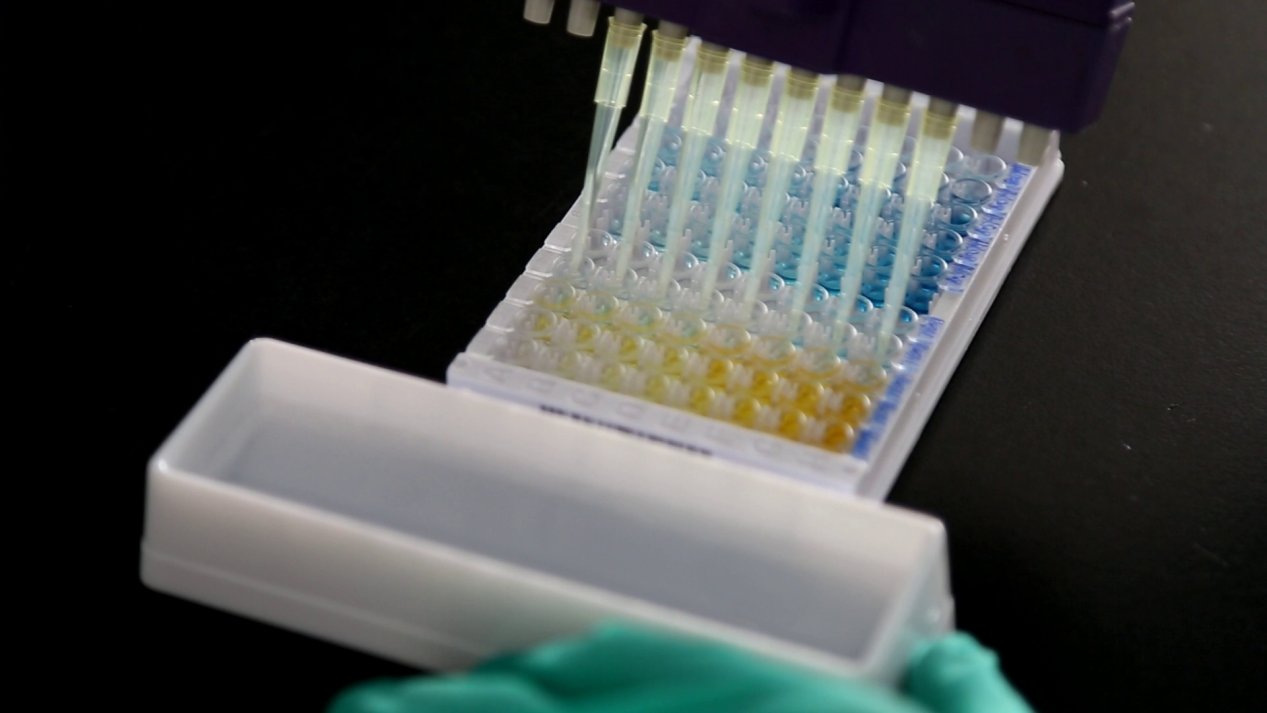
Figure 1: Multi-channel pipette transfers samples into microplate wells for ELISA testing
Unscrupulous suppliers skip the complex development of target-specific haptens and custom antibodies. They reuse generic reagent sets and simply re-apply new labels to create hundreds of supposed small-molecule kits. These kits generate impressive standard curves in buffer but cannot recognise genuine analytes inside biological matrices. Interferences from polyphenols, lipids and organic solvents including methanol, acetonitrile and DMSO create artificial optical-density shifts that mimic true measurement signals.
Researchers can mitigate risks starting at the procurement stage. Prices far below reasonable market levels should raise concern. Short-established vendors claiming an extremely broad catalogue of small-molecule ELISA products carry high risk, since each small-molecule assay requires independent hapten synthesis, carrier conjugation and antibody development. Claims of universal matrix compatibility must be supported by full method-validation datasets including limit-of-detection, intra-assay and inter-assay CV, cross-reactivity tables, spike-recovery and dilution-linearity results for relevant matrices, plus solvent-tolerance data. Reliable kits should show 75-125 % spike recovery for complex matrices, intra-assay CV < 10 % and inter-assay CV < 15 %. Investigators may pose targeted technical questions to technical support teams; questionable suppliers often cannot answer questions about solvent tolerance, matrix interference or hapten-carrier information.
Packaging and manual screening offers another critical checkpoint. Valid competitive ELISA kits contain coated microplates, labelled small-molecule competitors, reference standards, wash buffer, substrate and stop solution. Authentic documentation explicitly states the competitive-ELISA principle and provides sample-specific pre-processing instructions for serum, plasma and tissue homogenates. Warning signs include manuals copied from sandwich-ELISA templates, identical text reused across different analyte kits, missing validation metrics, and recommendations for loading crude sample stock directly without warnings for solvent-derived interference.
Figure 2: Laboratory technician transfers biological sample into storage vial ahead of ELISA assay
Experimental validation remains the definitive evaluation step. A strong standard-curve R² does not prove kit suitability for complex samples. Recommended verification tests include multi-matrix spike-and-recovery assays, free-analyte competitive-inhibition tests, organic-solvent blank interference assessments, dilution-linearity checks, structural-analogue cross-reactivity testing and blank-matrix negative controls.
Typical failure patterns for defective kits include consistent, near-identical measured values across all real-world samples despite excellent buffer-only standard curves; unchanged OD values even after adding high-purity free analyte; optical-density shifts triggered purely by organic solvents; wildly variable recovery across different sample matrices; and inconsistency between ELISA outputs and LC-MS/MS reference measurements.
Common fraudulent practices encompass relabelling generic competitive assay systems, producing standards that only function in buffer while plate-coating and conjugate reagents lack target specificity, repurposing sandwich-ELISA kits for small-molecule applications, diluting authentic assay components, and generating colour shifts driven by non-specific physicochemical matrix effects rather than true antigen-antibody interactions.
Figure 3. Practical Verification Checklist
Important note: Final kit fitness must be verified within each user laboratory using the researcher’s own sample matrices. Manufacturer-supplied validation data and third-party literature serve only as procurement references and cannot substitute hands-on pre-testing.
Small-molecule competitive ELISA risks frequently hide behind visually appealing standard curves. Relying solely on R² and intra-assay CV values can mislead researchers. Before launching formal experiments, users are strongly advised to complete spike-recovery, competitive-inhibition and solvent-tolerance verification to filter out mislabelled or over-marketed products. Hapten design, specific antibody generation and multi-matrix method validation constitute the core technical barriers for high-quality small-molecule ELISA development.
With nearly two decades of R&D experience, Cloud-Clone completes full-in-house development covering hapten conjugation, antibody screening and multi-matrix performance validation for every small-molecule target. Each assay undergoes rigorous testing for spike recovery, dilution linearity, cross-reactivity and solvent compatibility with well-controlled intra- and inter-batch variation. Cloud-Clone small-molecule ELISA kits support detection for hormones, metabolites, neurotransmitters and drug compounds, backed by abundant independent SCI publications. Cloud-Clone recommends all researchers perform spike-recovery and dilution-linearity pre-validation with their own sample matrices for every new kit lot, to safeguard data integrity and generate credible, publishable research outcomes.
About Cloud-Clone Corp.
Cloud-Clone Corp. is dedicated to the development and production of high-quality immunoassay reagents and detection solutions. With a focus on antibody engineering, multiplex assay development, and cross-platform compatibility, the company provides research tools designed to support precision medicine and advanced biomedical investigation globally. Our core products and services include the research and development of proteins, antibodies, ELISA kits, primary cells, and multiplex cytokine assay kits, as well as professional CRO services to fully meet the diverse needs of biomedical research and related fields.
For more information about Cloud-Clone Corp, visit www.cloud-clone.com.
CLOUD-CLONE CORP.(CCC)
Tel: 001-832-538-0970, 0086-27-8425-9552
Email: mail@cloud-clone.com, sales@cloud-clone.us
Visit us on social media:
LinkedIn: https://www.linkedin.com/company/cloud-clone-corp/
Instagram: https://www.instagram.com/cloudclonecorp2023/
TickTok: https://www.tiktok.com/@cloudclonecorp2026
SuKi Duan
CLOUD-CLONE CORP.WUHAN
Visit us on social media:
LinkedIn
Instagram
TikTok
X
Legal Disclaimer:
EIN Presswire provides this news content “as is” without warranty of any kind. We do not accept any responsibility or liability
for the accuracy, content, images, videos, licenses, completeness, legality, or reliability of the information contained in this
article. If you have any complaints or copyright issues related to this article, kindly contact the author above.

Media gallery